

Los Zetas
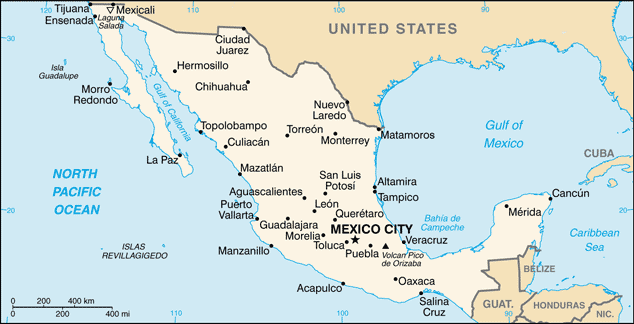
Mexico: narco-violence from Yucatan to Rio Grande
Six people were strangled to death and one decapitated in the Mexican tourist resort of Cancún April 14—the latest mass killing to strike the city in the last few weeks. Police found the bodies of the five men and two women in a shack in the outskirts of the Yucatan Peninsula city, which has largely escaped the drug-related violence that has rocked Acapulco, a faded tourist destination on the Pacific coast. Quintana Roo authorities said the vicitms were small-scale drug dealers. In a separate incident that day, police found the body of another man in Cancún who had been gagged, bound and wrapped in sheets. (AP, April 15) The slayings come one month after seven were killed when gunmen burst into Cancún's La Sirenita (Little Mermaid) bar, targeting members of the city's taxi-drivers who were who were holding a meeting there. Several Cancún taxi drivers had been arrested recently for selling drugs or participating in drug-related killings, authorities said. (AP, Univision, March 15)
Honduras: top prosecutor suspended amid violence
Citing frustration with mounting criminal violence, the National Congress of Honduras on April 16 moved to suspend prosecutor general Luis Alberto Rubí and his assistant, replacing them with a temporary oversight committee. The five-member commission, made up of leaders of the country's political parties, will have 60 days to analyze why the prosecutor's office, the Fiscalía General de la República, has made little headway on numerous criminal cases, and draft a plan to reform the institution. With a homicide rate of 90 per 100,000 residents, Honduras is often called the world's most violent country. Prosecutors solve only about 20% of homicide cases, on average. The National Congress estimates 20,644 homicides have gone uninvestigated in the 28 months of the current administration. (InfoSurHoy, La Prensa, Tegucigalpa, April 18; AP, NYT, April 17; La Prensa, April 16)
Narco-coal: Zetas diversify portfolio
Authorities in Mexico's coal-producing northern state of Coahuila say that the notorious Zetas, bloodiest of the country's warring cartels, have taken over much of mining industry. Suspicions were first raised in October when top Zeta commander Heriberto Lazcano was found in a Coahuila coal mining town and killed in a shoot-out with Mexican marines. Coahuila produces some 95% of Mexico's coal at approximately 15 million tons a year, and current estimates place the Zetas' annual profits from their share of the industry at around $25 million. Former Coahuila governor Humberto Moreira said the Zetas are expanding their control over the state's mines, both legal and illegal. "They discover a mine, extract the coal, sell it at $30, pay the miners a miserable salary," he told Al Jazeera. "It's more lucrative than selling drugs."
Mexican media mum on murderous mayhem
Two women are among the dead in a fierce gun battle that claimed five lives March 16 in Reynosa, Tamaulipas, just across the Mexican border from Hidalgo, Tex. Tamualipas state authorities said the women were among the combatants. The fire-fight came one day after Mexican federal police found more than five tons of marijuana, 370 pounds of crystal methamphetamine and a large weapons cache in underground bunkers in Reynosa—including 20 rifles, 10 bulletproof vests, a gas grenade, 20 uniforms, radios and tire spikes. March 11 also saw a three-hour gun battle in the streets of Reynosa, with rival narco-factions using automatic weapons and grenades. Authorities were absent for most of the shoot-out that left some three dozen gunmen and two bystanders dead—one just a teen. An exact death toll was elusive, as cartel gunmen collected their own dead during the battle.
Mexico called to task over disappeared
A new report highlighting Mexico's human rights crisis finds that security forces have taken part in many kidnappings and disappearances over the six-year term of President Felipe Calderón, with the government failing to investigate most cases. Despite some controversy over the numbers, an estimated 70,000 are believed to have met violent deaths under Calderón's militarized crackdown on the cartels. But the new report, released by Human Rights Watch Feb. 20, finds that on top of this figure, possibly more than 20,000 disappeared during Calderón's term. Many were abducted by narco gangs, but all state security forces—the military, federal and local police—are also accused in "the most severe crisis of enforced disappearances in Latin America in decades."
Mexico: Chapo goon popped —but still not Chapo
The Mexican military announced Feb. 10 the capture of Jonathan Salas Avilés AKA "El Fantasma" (The Ghost), accused of being the security chief for fugitive Sinaloa Cartel kingpin Joaquin Guzmán AKA "El Chapo" (Shorty), in Culiacán. Salas apparently surrendured after being surrounded by three helicopters and at least eight navy vehicles. In the typical confusion, the governor of Sinaloa last year mistakenly announced that Salas had been killed in a clash with Mexican Marines. (BBC News, El Universal, Sexenio, Feb. 10; Justice in Mexico, March 5, 2012) The arrest of a figure close to El Chapo while the kingpin himself remains at large has been reported again and again and again and again and again—leading to conspiracy theories that Chapo is being protected by the Mexican state, at the price of the occasional sacrifice of a lieutenant to save face.
Hezbollah link to Zapatistas? Not!
Israeli news portal YNet on Dec. 29 ran an incredibly irresponsible story entitled "Hezbollah's cocaine Jihad," the introdek reading: "Faced with dwindling Iranian funding, Shiite terror group partners with Mexican drug cartels; uses millions of dollars in drug money to support weapon acquisition habit." Now, this is a quesitonable claim at best, but before the story even gets to the rather sketchy evidence for this assertion it spends a full six paragraphs talking about Chiapas and the Zapatista rebels—complete with a prominent photo of masked Zapatistas marching with their red-and-black flag! The message sent to the uninitiated is that the Zapatistas are mixed up with both drug cartels and Hezbollah. What is the basis for this Hez-bollocks? There is none. The article notes that an Islamic micro-sect called the Murabitun has been converting Indians in Chiapas in recent years, but aside from the fact that they are both in Chiapas, there is no link between the Murabitun and the Zapatistas, and no link between either and the drug cartels. Furthermore, the Murabitun are Sunni not Shi'ite, and based in Spain not Lebanon—so not even remotely linked to Hezbollah.
Mexico: bloody Christmas in Michoacán, Sinaloa
At least 13 people, including seven police officers, were killed and eight others wounded in three shootouts involving police and "armed commandos" on the border of Jalisco and Michoacán states in west-central Mexico Dec. 23. The first incident came when Michoacán state police responded to a report of a traffic accident in Briseñas municipality and were ambushed. Similar gunfights shortly followed in the nearby municipalities of Quitúpan and Ayotlán. The following day, bullets flew in the central plaza of Yurécuaro, Michoacán, in what authorities called a shootout between the Knights Templar and Jalisco Nueva Generación cartel, leaving an unarmed bystander dead. Also on Christmas Eve, a group of armed men stormed the town of El Platanar de Los Ontiveros in the mountains of northwestern Sinaloa state, killing nine with assault weapons and dumping their bodies on a sports field. Authorities called that one a fight between the Sinaloa Cartel and the Zetas. (AP, Dec. 26; AFP, Dec. 25; EFE, Dec. 24; Milenio, Dec. 23)


Recent comments
5 days 5 hours ago
2 weeks 2 days ago
2 weeks 2 days ago
2 weeks 6 days ago
3 weeks 6 hours ago
3 weeks 1 day ago
3 weeks 1 day ago
3 weeks 2 days ago
3 weeks 2 days ago
3 weeks 3 days ago