
Osama bin Laden

Did Iran shelter Sulaiman Abu Ghaith?

Osama bin Laden’s son-in-law and al-Qaeda's one-time media voice Sulaiman Abu Ghaith was seized by CIA agents and taken to the US after Turkey deported him to Jordan this month, it was revelaed March 7. AFP reports that Abu Ghaith was seized by Turkish authorities last month at a luxury hotel in Ankara after a tip-off from CIA, and was held there despite a US request for his extradition. Turkey apparently deported Abu Ghaith to Jordan on March 1 to be sent back to his native Kuwait, but he was seized by CIA agents in Jordan and taken to the United States. In a revelation that could be convenient for the slowly mounting war drive, it appears that before arriving in Turkey, Abu Ghaith had been in Iran...

AQIM manifesto found in northern Mali: report

Britain's The Telegraph on Feb. 13 reports on a document reportedly found by their reporter in the ruins of a Gendarmerie Nationale barracks outside Timbuktu that had been used by the jihadists and then destroyed in a French air-strike. The document, purportedly the notes from a March 18, 2012 leadership meeting of al-Qaeda in the Islamic Maghreb (AQIM), chaired by AQIM "prince" Abu Musab Abdul Wadoud, is said to lay bare AQIM's plan to consolidate control of northern Mali, stating: "We had to think of the necessity to draw a plan to command and control the jihad activities there at this critical moment and target all efforts to achieve the required goals." The supposed document is portrayed as especially expressing concerns over Ansar Dine, the faction that controlled Timbuktu, as too independent. An AP account claims their own reporter found the document, and identifies Wadoud as nom de guerre of Abdelmalek Droukdel, the AQIM top commander supposedly appointed by Osama bin Laden.

Conviction of al-Qaeda media director vacated

The US Court of Appeals for the District of Columbia Circuit on Jan. 25 vacated the conspiracy conviction of Ali Hamza Ahmad Suliman al-Bahlul (HRW profile), former media secretary of Osama bin Laden. The DC Circuit ruled that the military tribunal that convicted al-Bahlul of conspiracy in 2007 erred because a Guantánamo prisoner could not be convicted of conspiracy unless his crime took place after 2006. The court explained that the Military Commissions Act of 2006  codified conspiracy as a war crime, but did not apply to crimes committed before the MCA was passed. Al-Bahlul was captured in 2001. The US has 90 days to appeal the DC Circuit's decision to the US Supreme Court.

UK denies extradition request for Jordanian cleric

The UK Special Immigration Appeals Commission (SIAC) on Nov. 12 granted the appeal of Muslim cleric Abu Qatada (BBC profile), blocking his extradition to Jordan, where he is accused of organizing bomb attacks. Qatada has been described as "Osama bin Laden's right-hand man in Europe," and UK officials believe he should remain in prison for national security reasons. While never formally charged with an offense in the UK, he has for years been in and out of custody—either imprisonment or house arrest. The judge stated he did not believe Jordanian authorities would mistreat Qatada, but Jordan allows use of evidence gained as a result of the torture of others, and thus Qatada could not receive a fair trial.

Al-Qaeda faces Syrian revolution with "crossroads"

After last week's terror blasts in Aleppo, we noted a report in the New York Times to the effect that the US is pressuring Saudi Arabia and Qatar to hold back their support to the Syrian rebels for fear the arms could fall into jihadist hands. Now, the Times runs another story informing us that a "jihadist insurgent group" called the Nusra Front for the People of the Levant has claimed responsibility for last night's suicide attack on an intelligence compound on the outskirts of Damascus—and that the same group also took credit (on a "Qaeda-affiliated Web site") for the Aleppo blasts.

Bloodshed in Benghazi as citizens confront militias

Four protesters were killed in Benghazi Sept. 21 and over 20 wounded when citizens moved against militia groups in the eastern Libyan city, storming and occupying their bases. Hundreds of weapons were pilfered, and vehicles set ablaze. Among those seized was the headquarters of Ansar al-Sharia, the Islamist militia linked to the attack on the US mission in the city that killed the ambassador and three other US personnel. The stage was set for confrontation when Ansar al-Sharia called a rally of its own supporters in the city's central Shajara Square after the "Save Benghazi" rally—to oppose the lawless militias that continue to operate with impunity in the city—had been called for the same time and place. "Ansar al-Sharia have done this deliberately," said Bilal Bettamir, an organizer of the Save Benghazi rally. "We have been planning our march for the past week, and they made their decision yesterday. They knew all about it." But the jihadists apparently retreated as some 30,000 advanced on the plaza after Friday prayers, chanting "No, no, to militias," with banners reading "The ambassador was Libya's friend" and related slogans. After rallying in the square, groups of protesters started to overrun the militia bases. The four were killed while attempting to occupy the base of the Raf Allah al-Sahati Brigade, another Islamist militia.

The left and the jihad: love-hate relationship?

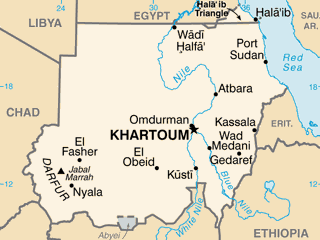
We've been waiting for the other shoe to drop in Mali ever since April, when Tuareg rebels seized power in the north, only to be shortly overthrown themselves by an alliance of jihadist militias. Yeah, this is the middle of the Sahara, but how long is the "international community" going to allow an unrecognized extremist-controlled rogue state the size of France to persist? The jihadists continue to up the proverbial ante. Over the weekend, the Movement for Unity and Jihad in West Africa (MUJAO) advanced into Mopti region, south of rebel-held Timbuktu, seizing the town of Douentza. (See map.) Unbelievably, it appears that this border zone on the edge of the vast rebel territory has been abandoned by the government, and the town was defended only by a local militia, the Ganda Iso (Sons of the Land)—one of several that the region's residents have been organizing autonomously to defend against jihadist aggression or (much more ambitiously) to eventually take back the north. MUJAO also made good on their threat to put to death an Algerian vice consul they had abducted. Mali's government this week reportedly made a formal request for military intervention to the Economic Community of West African States (ECOWAS), but is apparently refusing to confirm this to its own people, making no mention of it in state media. (AP, Sept. 7; Middle East Online, Sept. 3; MEO, Sept. 2; AFP, Aug. 31)

US appeals court upholds life sentence of convicted al-Qaeda operative

The US Court of Appeals for the Second Circuit on Aug. 24 upheld the life sentence imposed on a former Osama bin Laden aide after he stabbed a prison guard in the eye in 2000. Mamdouh Mahmud Salim, 54, is a Sudanese-born Iraqi who at the time of the stabbing was awaiting trial in a conspiracy case that included the 1998 attack on US embassies in Kenya and Tanzania. In 2002 Salim pleaded guilty to attempted murder of and conspiracy to murder a federal official after he stabbed Louis Pepe, a guard at the federal jail in lower Manhattan, with a plastic comb in November 2000. Salim appealed his sentence primarily on the ground that his right to be physically present at the sentencing hearing was violated when he attended by videoconference. The court ruled that the US District Court for the Southern District of New York erred in finding that the government had met its burden of proving that Salim had waived his right to be present at the hearing, but under plain error review found that Salim was not prejudiced by the error. The court also rejected Salim's arguments that the life sentence was unreasonable.

Syndicate content