
Urabá

Colombia: peace talks advance amid violence

"Pablo Catatumbo," commander of the FARC guerillas' feared Western Bloc, was picked up by a Red Cross helicopter in Colombia's southwestern town of Palmira April 6 to join fellow guerrilla leaders who are in Cuba meeting with the government to negotiate peace, according to local media. Neither the government nor the FARC have either confirmed or denied Catatumbo's trip. With the arrival of Catatumbo, the FARC delegation in Havana now includes three of the guerillas' seven-man secretariat. To allow the safe arrival of Catatumbo and five other rebel leaders in Palmira, the army temporarily suspended military operations in the department of Valle de Cauca, military intelligence sources told Caracol Radio. (Vanguardia Liberal, Bucaramanga, April 7; Colombia Reports, RCN Radio, April 6)

Colombia: tribunal rules for Peace Community

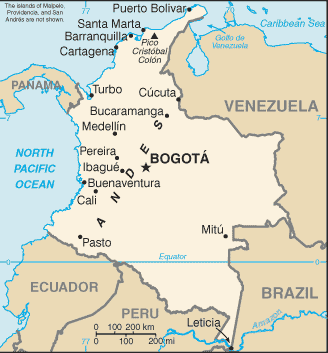
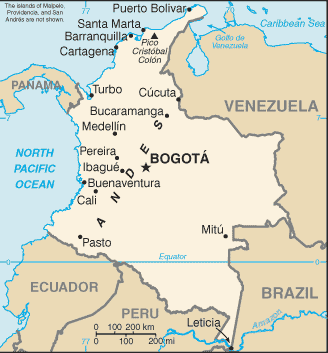
The Administrative Tribunal of Colombia's Antioquia department on Feb. 8 ordered the national army to hold a public ceremony officially apologizing for the massacre at San José de Apartadó Peace Community, almost exactly eight years after it was carried out. In the Feb. 21, 2005 attack, six adults and two children were killed at the village in Apartadó municipality of Antioquia's northern Urabá region, where residents had declared their non-cooperation with all armed actors in Colombia's civil conflict.

Colombia: ICC "false positive" probe advances

On Nov. 15, the International Criminal Court (ICC) gave Colombia a clear warning that the Court expects accountability at the senior level for the serious crimes that fall under its jurisdiction, or else it may pursue a formal investigation. The warning came in the first interim examination report ever issued by the Court's Prosecutor Office. Colombia joined the ICC in November, 2002 and is one of only eight countries formally under ICC examination. The other countries are Honduras, Afghanistan, Nigeria, Georgia, Guinea, North Korea and Mali.

Colombia: army general gets 25 years for para collaboration

A retired Colombian army general accused by prosecutors of forming a "macabre alliance" with illegal paramilitary groups was sentenced to 25 years in prison Aug. 24 in connection with the 1997 murder of a peasant leader. The sentencing of former general Rito Alejo del Río Rojas brings closure to a case that has long languished in the Colombian justice system and focuses renewed attention on the collaboration between top military officers and paramilitaries affiliated with the United Self-Defense Forces of Colombia (AUC).

Colombia: San José de Apartadó Peace Community under attack again

The San José de Apartadó Peace Community in Colombia's northern Urabá region, one of several citizen peace initiatives by local communities demanding their right not to take sides in the war, is once again under threat—seven years after a massacre that forced many residents to flee the village. Several outlying hamlets (veredas) continue to adhere to the Peace Community, and their leaders are now facing escalated harassment. On July 30 and 31, Germán Graciano, a Peace Community leader, received phone calls from men who identified themselves as members of the Gaitanista Self-Defense Forces of Colombia, a paramilitary group. The callers demanded he agree to collaborate with them, or "purchase coffins for himself and his family."

Colombia: blows against narco-para network?

Erikson Vargas AKA "Sebastian"—purported leader of the Medellín-based crime syndicate Oficina de Envigado—was captured by Colombian National Police on Aug. 8. in Copacabana, a town just outside the country's second-largest city. Police said one of Sebastian's bodyguards was killed when police stormed his hideout. President Juan Manuel Santos praised the arrest as a "super-blow" against organized crime and promised a "gold medal to the police" for the capture. (Colombia Reports, BBC News, Aug. 8) That same day, Luis Fernando Jaramillo Arroyave AKA "Nano"—a top commander of Los Urabeños paramilitary group—was extradited to the US on drug trafficking charges. Nano, also said to have founded Los Paisas paramilitary group, was captured in Medellín in February 2011 and later sentenced nine months on charges of murder, drug trafficking and conspiracy. (Colombia Reports, Aug. 8)

Syndicate content